‘Memory is cruel, we call on it to rekindle burnt out fires, but with the years, it fades, leading us down phantom paths, like beggars searching for traces of our past, towards houses that never existed. Memory is their punishment, mine lay in my beginning. Violence endures, its medusa-like tentacles live on. I have become a second-generation coloniser. I shall not be loved here.’
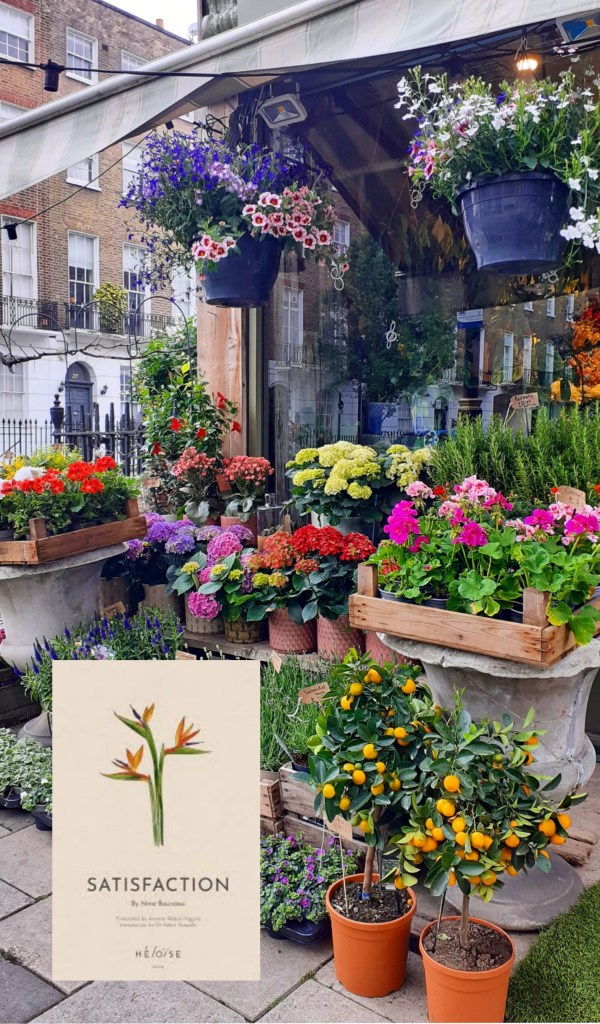
Satisfaction is a complex cocktail of jealousy, desire and self-loathing, set against the backdrop of a nation in recovery, where the scars of violence run deep. In her ‘notebooks of shame’, Michèle Akli, a Frenchwoman living in Algiers with her husband Brahim and their son Erwan, lays bare intense feelings of yearning and envy, rooted in a crippling fear of losing her child’s affections. Though undoubtedly aware of her own paranoias and prejudices, even denouncing herself as a ‘leech mother’, she is unwilling, or perhaps unable, to disentangle her sense of self from the boy.
This emotional turmoil reaches a pinnacle with the introduction of Erwan’s friend Bruce, and her mother, Catherine, who subsequently becomes the obsessive focus of all Madame Akli’s repressed frustrations and desires. A considerable part of the two women’s association is fabricated, built from imagined scenarios and conversations that the protagonist plays out in her mind; this parallel experience remains unvalidated by the subject of her fantasies, thus, these repeated thoughts become a form of masochism. It is unclear how much of the infatuation is specific to the character of Catherine, or whether it could have attached itself to any individual who appeared at this moment in time, a diversion for the inner turbulence she was experiencing.
Michèle’s relationship with Bruce is even more convoluted; her open contempt towards her son’s friend is uncomfortable at best, and ruinous at worst. Their interactions reveal the narrator’s nihilistic attitude towards women, laced with what she herself identifies as ‘latent misogyny’. She surmises that Bruce has taken the name of her idol, Bruce Lee, in ‘a bid to alter her fate’ and that ‘male violence has drawn out her femininity’. There is an indirect connection here to an earlier comment on clothing, as the notebook’s author admits to consciously choosing loose-fitting garments -’long skirts don’t arouse any desire’ – as a protective measure against the attention of men in the city and the danger this represents. Femininity is stifled by an instinct of self-preservation. Considering this, could it be suggested that an element of this misogyny is born of fear and vulnerability, and resentment of these sentiments?
There is a duality to Madame Akli’s gendered hostility; it’s tied up in both the threat of violence from men and of competition from other women, for the attention of the male figures in her life.
‘I never wanted a second child, I didn’t want to risk having a girl, I wouldn’t have known how to bring her up, I’d have been jealous of her relationship with Brahim, with Erwan. I’m the only woman in my household, the mirror image of Catherine. Women don’t like other women.’
This final statement reiterates a darker undertone in the exchanges between Michèle and Catherine – though outwardly admiring of this new female presence, she is also envious. Simultaneously, it sheds light on the conflicts at the core of the former’s relationship with Bruce. On the one hand, there is concern that Bruce’s distortion of traditional gender boundaries will influence Erwan; his mother doesn’t want to think of him ‘playing the girl’, thereby making him as fragile as she perceives the position of women in Algiers to be. On the other hand, any friendship between her son and Bruce is a risk to the maternal bond and it seemed, at least to me, that this was far greater fuel for her animosity than Bruce’s androgynous presentation.
Laden with visceral sensuality and evocative description, Satisfaction is a chronicle of envy, longing and pain, and an important contribution to the growing catalogue of translated fiction in the UK. As Professor Helen Vassallo writes in the introduction to the novel:
‘[The fact] that Bouraoui’s work sits so well with such a range of titles (commissioned in translation by a variety of publishing houses) is a testament to both its literary merit and its universal appeal. It also highlights the importance of making space for women’s writing – particularly texts from other cultures that focus on marginalised experiences – in the Anglophone literary market, an endeavour that characterises the work of Héloïse Press’
Satisfaction by Nina Bouraoui (translated by Aneesa Abbas Higgins), Héloïse Press, November 2022
 Bookishly Abroad