‘Connell wished he knew how other people conducted their private lives, so that he could copy from example …’ (p.49)
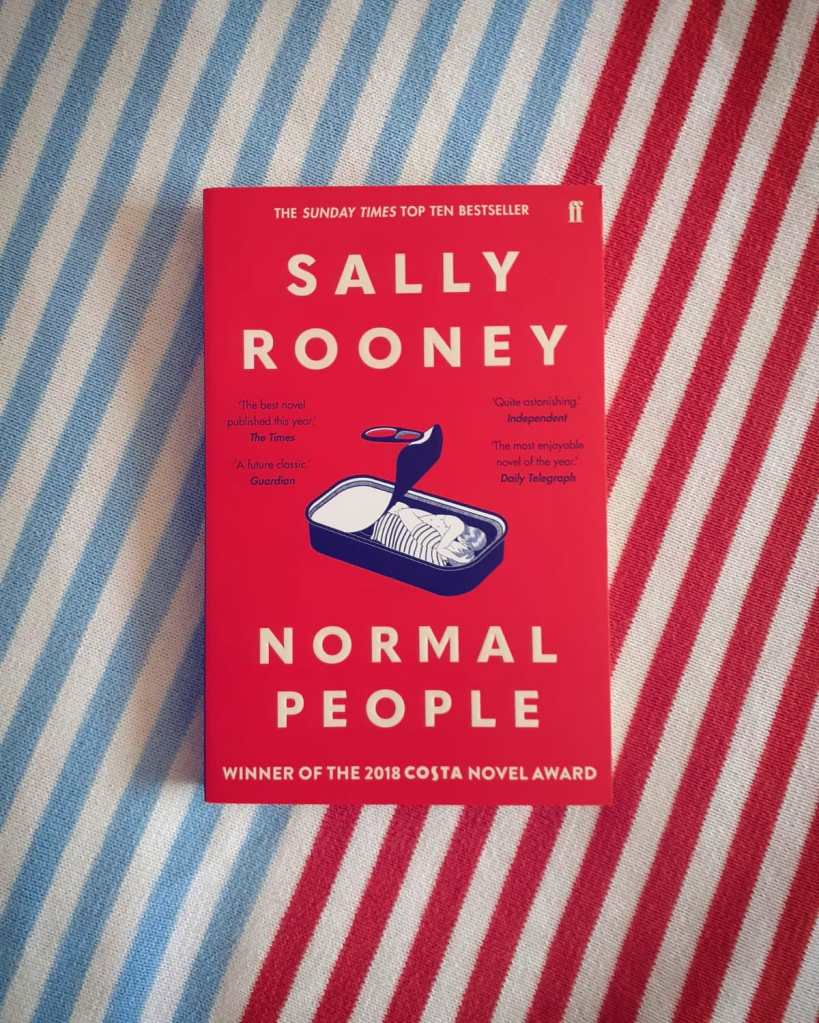
I have very mixed feelings about this book. Everyone raved about it when it was first published but it’s been sat on my shelf for a while, gathering dust. I finally picked it up because the series was about to be released … though now I wish I’d read it before even seeing the trailer – maybe I’d have imagined the characters differently. Overall, I liked the novel but found it dragged a bit; although I did want to know what happened next, I wasn’t desperate to find out, and it took me the best part of a month to finish, but this might say more about my attention span than the novel! Perhaps if I’d had read it over just a few days, this would not have been the case?
What I didn’t like:
At times I found aspects of the main characters and their story-line frustrating, both in terms of their individual behaviour and ‘back and forth’ nature of their relationship. My attitude towards the two of them changed constantly throughout the novel. Connell’s treatment of Marianne at school was irritating, and he fully deserved the tongue-lashing he got from Lorraine. But, however unfortunately, it is fairly realistic. You could argue that part of what makes this section so uncomfortable is that readers remember their own experiences of secondary school, ‘imbued with such drama and significance’ (p.77) at the time. The hyper-awareness of others’ opinions and changes in behaviour accordingly, maybe in a way they’d now be ashamed of. Whatever the reason, the early tone of the novel touches a nerve.
As such, there is something very universal in Connell’s realisation that no one cared as much as he had thought:
‘This was the most horrifying thing Eric could have said to him, not because it ended his life, but because it didn’t. He knew then that the secret for which he had sacrificed his own happiness and the happiness of another person had been trivial all along’ (p.77)
Marianne’s ambivalence to other people’s opinions is arguably a trait to be admired. However, this initial display of fierce independence makes it all the more frustrating and upsetting that she allows Jamie, then Lukas to treat her so badly; Connell voices (or rather internally monologues) a similar opinion.
The chronology also took me a while to get my head around; the first few chapters are a little jolting but then you get used to the structure – it reminded me of ‘One Day’, skipping to certain points of their relationship, and then filling in the gaps retrospectively.
The speech formatting – I know this is an artistic choice and a silly thing to complain about but at times it was hard to tell what was speech and when we’d moved back to internal dialogue.
Peggy – a terrible friend and person …
What I liked:
I was frustrated by Marianne and Connell at times but writing this review, I’m reminding myself that good writing isn’t creating completely likeable characters – that would be unrealistic, not to mention boring! Generating any emotional reaction, positive or negative, to words on a piece of paper means the author has achieved something.
I empathised with both of them at different points, especially with Connell’s anxieties about university and the opinions of other. They are both flawed, but you can see over the course of the book how they make each other better people. For me, the ‘normal’ presentation of their relationship worked well – it wasn’t sensationalised/overly-romanticised but was still intimate and affecting.
Sally Rooney writes three-dimensional characters very well, in the sense that she shows all sides of them – not just the good and the bad, but the mundane moments, their silliness and humanity. What I particularly enjoyed was her talent for making you like the character but understand why other’s might not … I can easily imagine that if I were to bump into Marianne at a party, I might well share Helen’s opinion, finding her self-absorbed and irritating. But with context and the insight of how Connell views her, she is presented differently. Equally, though you have the internal dialogue from Connell that explains his decisions/rationalises his decisions from his perspective, it’s easy to see how these actions are confusing to other people and have the potential to hurt those around him, however unintentionally.
Also, I like learning new things and I now know what a ‘press’ is in Ireland …
 Bookishly Abroad