Review: Pages & Co – Tilly and the Bookwanderers by Anna James

A slight departure from my last few reads but a welcome change! 

Following the bibliophilic adventures of Tilly Pages and her friend Oskar, this is the first book in what is now a series of five, with the fifth part, The Treehouse Library, publishing today in the UK! 

Anna James opens the door to Pages & Co, run by Tilly’s grandparents Elsie and Archie, and surely the shop of any bookworm’s dreams!? 

The shop was made up of five floors of corners and cubbyholes, sofas and squashy armchairs, and a labyrinth of bookshelves heading off in different directions. A spiral staircase danced up one wall, and painted wooden ladders stretched up into difficult-to-reach corners. Tall arched windows made it feel a little like a church when the light spilled in and dust motes danced in the air. When it was good weather the sun pooled on the floor and the bookshop cat – named Alice for her curious nature – could often be found dozing in the warmest spots. During the summer the big fireplace behind the till was filled to bursting with fresh flowers, but as it was October a fire was roaring there.’ 
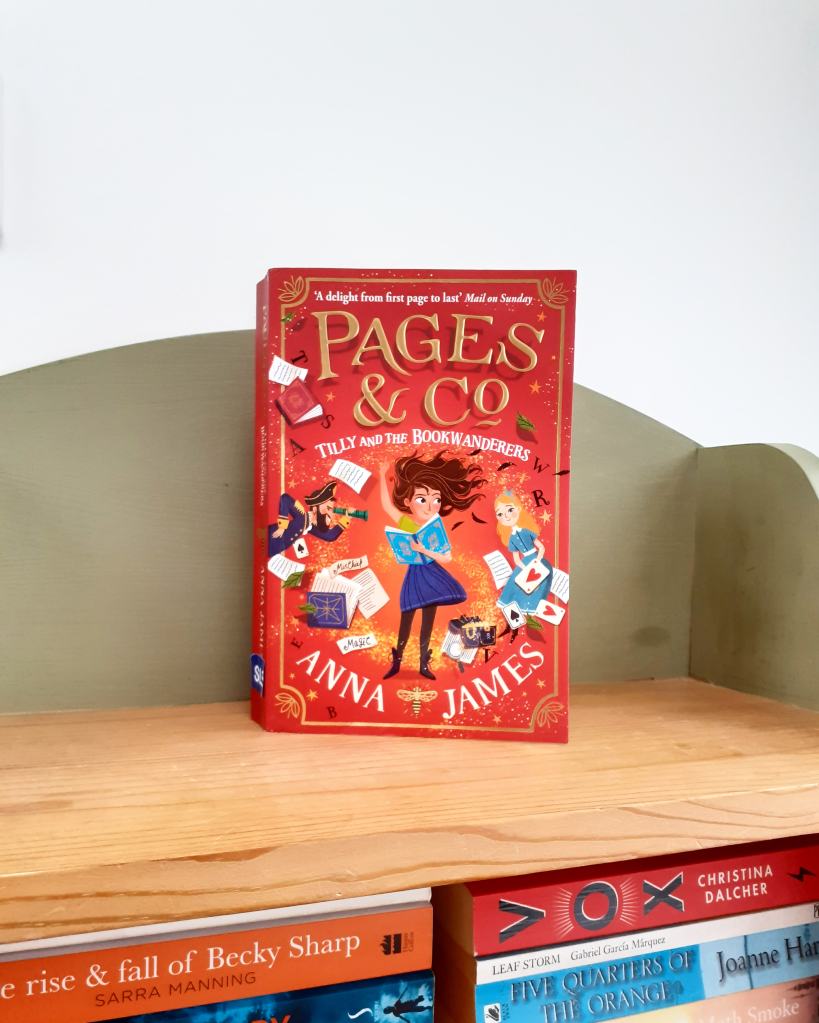
But when Tilly encounters two strangely familiar new friends, first Anne, “with an e” and then the inquisitive Alice, her family’s illustrious bookwandering history is revealed, setting in motion a chain of events that will change her life forever! 

Together with Oskar, she visits the Bookwanderer headquarters, the British Underlibrary, where they meet the (perfectly named) chief Librarian, Amelia Whisper, and discover the full extent of their newfound talents; not only are the pair able to interact with their favourite characters, but they can travel into the pages of the books themselves! There are, of course, rules, sternly enforced by another employee of the library, Enoch Chalk, the antithesis of the friendly Amelia, and of whose ulterior motives the children are immediately suspicious.  

Delving further into the uncharted territory of bookwandering, the friends’ adventures bring them closer to answers Tilly has longed for since her mother’s mysterious disappearance. But once revealed, the truth is beyond anything she could ever have expected, or even believed …  

I didn’t really pick up this title so much as it was thrust into my hands by an excited group of Year 6s, raving about the series at our class book club.  

It’s undoubtedly a series written with book lovers in mind, the children who read under the covers with a torch well past bedtime. There are parallels with the Inkheart trilogy, one of my own childhood favourites, though not so much as to overpower this story – it certainly stands up on its own. It’s also aimed slightly younger, middle grade if I were to give it a category, whereas Inkheart is darker and more complex. In any case, I’d like to think Tilly Pages and Meggie Folchart would be friends. 

This reminded me of what I love about children’s books and YA; the willing suspension of disbelief required is refreshing. Following an afternoon immersed in Pages & Co, it may seem perfectly plausible that you would happen upon Lizzie Bennett one rainy afternoon in London. Admittedly, I wasn’t entirely convinced by the Captain Crewe plotline but hopefully this will be developed in Tilly and the Lost Fairytales.  

I was gifted the next two books at the end of the school year, so looking forward to seeing what Tilly does next!  

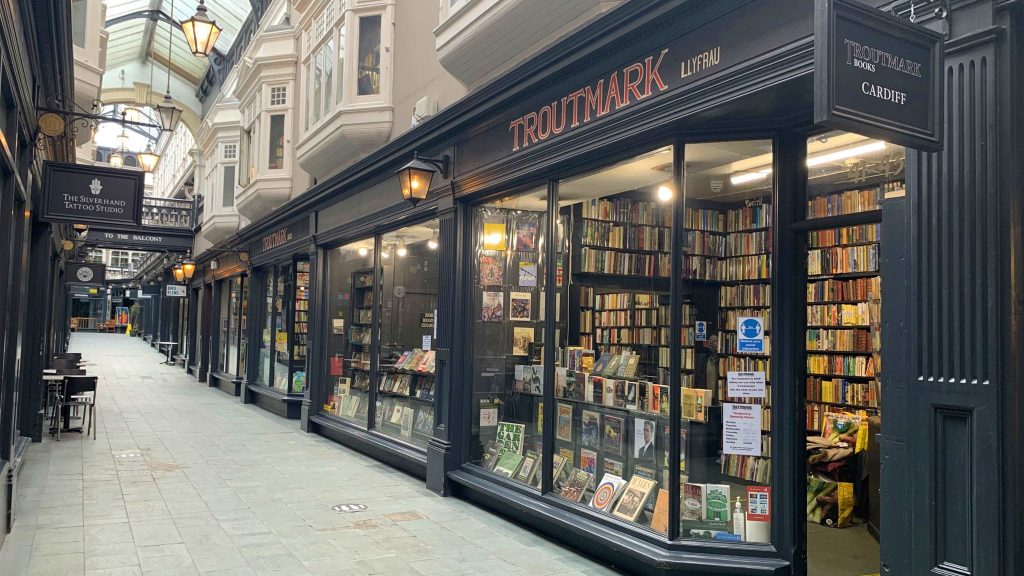
Troutmark Books

This month’s issue of The Indie Insider is a special edition celebrating our favourite independent bookshops!

Featuring brilliant pieces on Lighthouse Books, The Common Press and News from Nowhere, we hope to encourage our readers to seek out and support local booksellers 💜

I’ve chosen to include Troutmark Books – rainy day haunt and student loan depleter:

Tucked away in Cardiff’s maze of Victorian and Edwardian arcades, Troutmark Books is a veritable treasure trove for book lovers of all kinds. The arcades themselves are well worth a visit; filled with over 100 independent shops, selling everything from vintage clothes to specialist cheeses and weirdly wonderful flavours of Welsh cakes, it would be easy to spend all day wandering the quirky corridors. Even after three years living in the city, I still found something new each time I ventured in.  

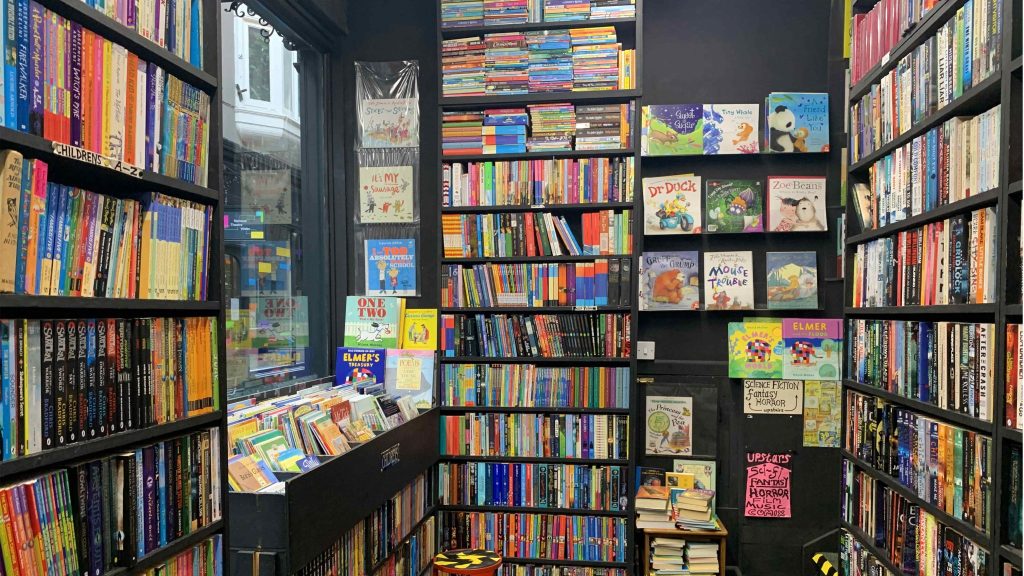
And Saturday city centre trips would always end at Troutmark. Peering through the windows of the black shopfront, beneath the red stencilled logo, you can see row upon colourful row of second hand books, stacked (often double) on floor-to-ceiling shelves. Their contents are eclectic: bestselling and niche fiction alike, comics, history, poetry, first editions, Welsh-language books, and an entire row of red-spined Vintage classics. One of my favourite sections is actually the corner of children’s books, where I’ve found many a forgotten favourite over the years.  

With the relaxed atmosphere, there’s no pressure to purchase – you are free to peruse for hours and leave empty-handed, though I have never walked out of the door with fewer than three acquisitions. On my last visit, I picked up an Isabel Allende memoir, a copy of The Borrowers and a beautiful Penguin Essentials edition of A Room with a View. High stock turnover means there’s always something new to discover, often a book you didn’t know you were looking for, and Cardiff’s large student population makes this place a godsend for thrifty English Lit students. You can find your entire reading list for a third of the price, often with helpful pencil notes included!  

It’s hard to ignore the threat conglomerates and online retailers pose to independent booksellers, but visiting somewhere like Troutmark is quietly reassuring, proof that the experience of a good bookshop cannot be replicated. 

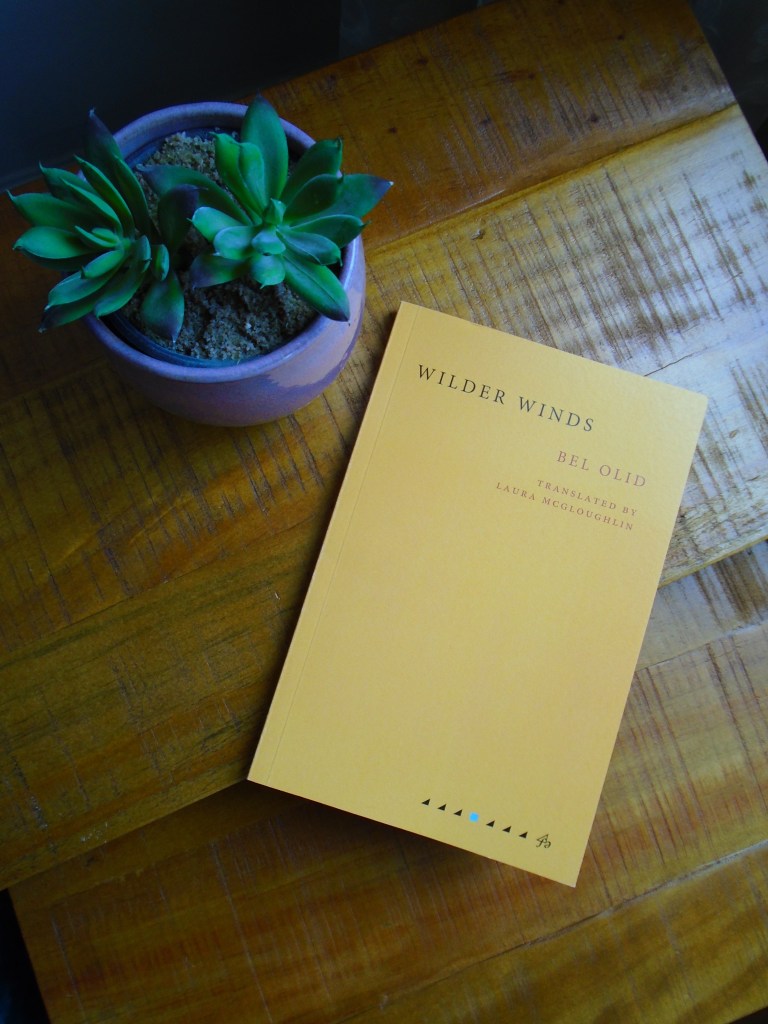
Review: Wilder Winds by Bel Olid

“Time passes like a veil that polishes your memories and makes them malleable”  

My favourite read of the year so far! This magnificent collection, eloquently translated by Laura McLoughlin, presents captivating fragments of its characters’ lives, delving into the innermost vulnerabilities of the individual, while also baring intimate truths of humanity as a whole.  

Wilder Winds – published by Fum D’Estampa Press

With short stories, no more than a few pages, Bel Olid pulls the reader to the brink of overwhelming tragedy but never completely over the edge; they are always salvaged by pockets of hope, moments of quiet defiance: gifted bunches of toadflax, morning coffee savoured while listening to the radio, a dip in the bluest of seas. This resilience threads itself throughout the book, bold in the face of suffering – as the narrator of ‘Cabaret’ muses, “life is stubborn and we cling to it even when it hurts to live’.  

Bearing pain, both physical and emotional, is an integral element across the collection. Almost every story is set against the backdrop of a historical conflict, from Lithuania’s Singing Revolution in ‘Dainuojanti Revoliucija’ to the worlds of Venezuela, Spain and New York drawn together in ‘Linda’. ‘Baba Luba’ takes place in Ukraine, amidst the civil unrest of 2014 and, though first published in 2016, this story’s current poignance is startlingly.  

Yet, we are continually reminded that the characters are not defined solely by their circumstances, as universal themes of loneliness, love, loss and friendship are addressed. The narratives shine a stark light on issues of gender politics, migration and social violence. Human connection in varying forms, across generations and continents, can be found at book’s core – exemplified in ‘Anna, Anne, Anna, where a young girl finds understanding in the words of Anne Frank. Often, in fact, the author focuses their lens on the young, raising questions as to how their lives will be affected by these formative experiences, marred by intense hurt, guilt or violence. We are left, however, reassured of their resilience, of the place they will carve out in an uncertain future.  

Wilder Winds is a gathering of deft, affecting narratives that are together enduring and unique. Olid’s talent for revealing whole lives through the keyhole of one particular moment is exceptional; pervading truths, some cruel, some delightful, are exposed in as little as two pages. I couldn’t phrase it any better than Marta Rojals – ‘Bel Olid tells you the most terrible things in the most beautiful way”.  

https://tinyletter.com/theindieinsider/letters/issue-19-short-and-sweet

This month’s Indie Insider theme is ‘Short and Sweet’, also featuring the minis series from Red Circle Press, Love Stories for Hectic People by Catherine McNamara and some exciting news from Peirene Press!

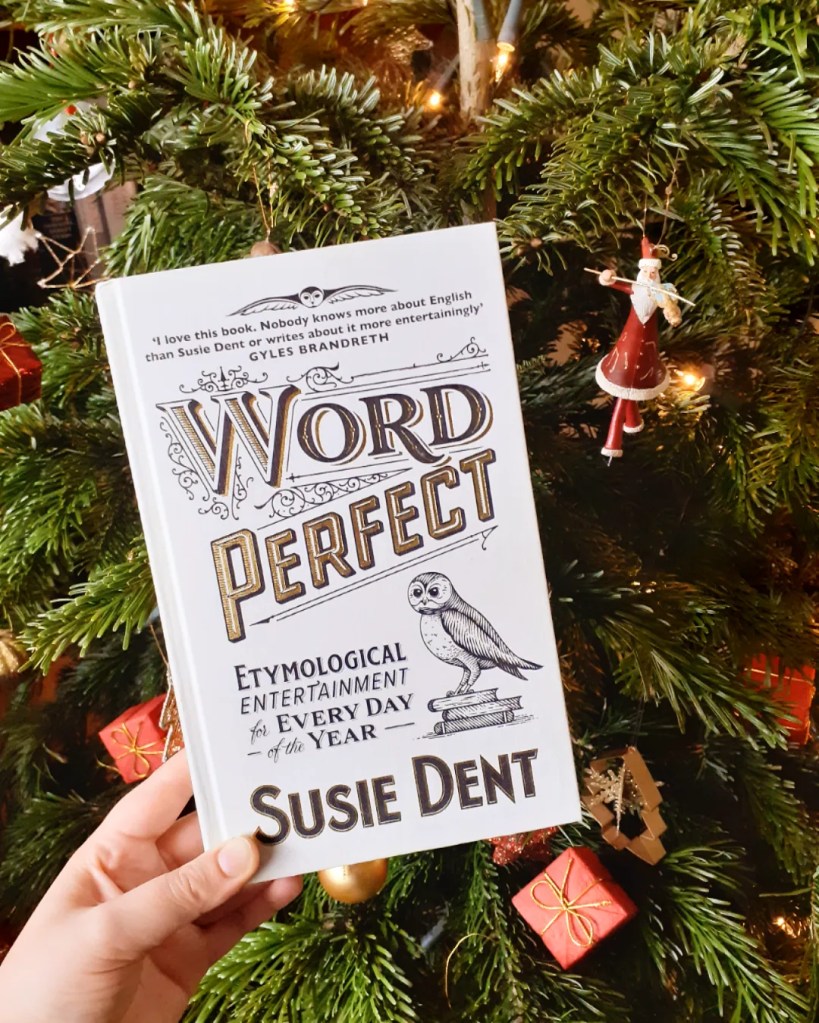
Word Perfect – October/November/December

Finally reached the end of a very lexically-laden year here at Bookishly Abroad, thanks to the marvellous Susie Dent. If you’ve enjoyed my picks, I cannot recommend the whole book enough!

I hope you all had a very merry Christmas and here’s to a brilliant 2022! 🥂

October:

1st – INWIT – refers to common sense or ‘inbuilt wisdom’. The total opposite of nitwit …

6th – SILVER SCREEN – now a metonym for cinema in general, originating from the earliest projectors screens, which were coated in silver paint.

12th – UNASINOUS – from one 1656 entry in the OED, meaning ‘united in stupidity’. I’m sure I’ll be finding a use for this one!

16th – FAN-BLOODY-TASTIC – the meaning is clear but I had no idea these infixes have a name in linguistics. The process of inserting one word into the middle of another is called ‘tmesis’, from the Greek ‘to cut’.

17th – CUDDLEMEBUFF – an excellent slang term for liquor.

22nd – CORONACOASTER – one of the many pandemic-born additions to our vocabulary, making it sound considerably more fun than it has been …

November

4th – EXSIBILATE – a neighbour of ‘booing’, this Latin word means to hiss an inadequate performer off the stage.

12th – POWWOW – borrowed from Algonquian, this comes from the name of a sacred Native American ceremony that often features dances, singing and vibrant traditional dress.

16th – JACK THE LAD – the namesake of this idiom was Jack Sheppard, a thief and folk hero of the 1700s, known and celebrated for his daring prison escapes. He was referred to affectionately by this moniker or, ironically, ‘Honest Jack’.

19th – PERISSOLOGY – put succinctly, using far more words than necessary!

25th – SPHALLOLALIA – the original working title for Tinder … From the Greek for ‘stumble-talk’, Susie defines this as “flirtatious talk that goes absolutely nowhere”.

December

12th – THROTTLEBOTTOM – an incompetent, bumbling individual in public office. The book uses Boris Johnson as its example …

16th – ZHUZH – to make something more lively or exciting. I’ve only heard this one used relating to hair and must never have written it down; before now, I wouldn’t have had an orthographical clue!

18th – BRUME – a winter mist.

20th – QUAFFTIDE – very aptly for December, the OED defines this as ‘the season for drinking’.

22nd – SCURRYFUNGE – frantically tidying before the arrival of guests. Also appropriate for this month in particular.

25th – CONFELICITY – finding joy in the happiness of others. The antonym of ‘schadenfreude’.

28th – MERRYNEUM – the endless stretch between Christmas and New Year when we’re lost in a blur of alcohol, leftover turkey and sitcom repeats. Also known as ‘Twixtmas’ or ‘Chrimbo Limbo’.

xxx

P.S. I got another of Susie’s books, What Made the Crocodile Cry?, for Christmas so I’m afraid my fangirling is far from over!

Word Perfect – August/September

A few linguistic gems selected from Queen Susie’s August and September offerings:

August

2nd – TESTICULATING – gesturing dramatically while talking absolute bollocks. One of many ‘blended’ words recently entering our lexicon, joining ‘hangry’ and ‘textpectation’. Apparently, The Washington Post also runs a competition to create new vocabulary by altering only a single letter of an existing word. One that needs to be added to the dictionary immediately is ‘sarchasm’, the gulf between the individual delivering sarcastic comments and an intended recipient who remains oblivious.

7th – CONSPUE – a niche (and gross) verb meaning to spit on someone with contempt.

10th – THE FULL MONTY – supposedly due to General Bernard Montgomery, an eccentric commander during the Second World War, who favoured a full English breakfast (‘the full works’) each morning. This origin is contested, but remains by far the most popular story.

17th – RHOTACISM – those unable to correctly pronounce the ‘r’ sound suffer from rhotacism, an arguably cruelly spelt diagnosis …

20th – HALCYON – tranquil and happy (usually referring to ‘days’). From the Greek myth of Alcyone who, upon drowning, was transformed by the gods into a kingfisher. Divine intervention from her father, Aeolus, god of the winds, allowed her to build her nest each year on calm waters untroubled by storms.

31st – ZWODDER – the perfect adjective for hot summer days – a drowsy state of mind and body, plausibly caused by daytime drinking.

September

2nd – MUBBLE FUBBLES – the melancholic feeling on a Sunday evening or at the end of a holiday, as a return to work looms.

4th – GENERCIDE – becoming generic. Often used to refer to brand names that have become synonymous for the service they offer e.g. Hoover, Band-Aid, Blu-Tack and Google.

9th – SLOGAN – from the Scottish Gaelic, sluagh-ghairm (war cry).

12th – CONKER – a major player in the autumnal lexicon, most likely from a dialect word for snail shell. Perhaps not the most gripping origin story but I had to include this one, as the explanation points out that the winners of conker games are know as ‘conkistadors’!

18th – GOSSAMER – a satisfying sibilant addition, thought to be a shortened version of ‘goose-summer’, referring to the popularity of goose in the autumn months.

25th – BOONDOGGLE – any project that is completely unnecessary or a total waste of time.

Word Perfect – April/May

A selection of April and May’s lexical offerings – I’ll pretend combining the two was a stylistic choice rather than an accidental necessity, as I forgot about April …

April

7th – HAIR OF THE DOG – turns out this one is decidedly literal! A shorted version of ‘a hair of the dog that bit you’ harking back to the medieval belief that once bitten by a dog, you could only be cured with a poultice containing one hair from the same animal. The entry also mention the delightful ‘wamble-cropped‘ as a synonym of ‘hangover’.

10th – COMET – one specific phrase springs to my mind considering the origins of this word – “it’s very Greek” (Julie Walters, Mamma Mia, 2008). It comes from ‘komētēs’, meaning ‘long-haired star’. As Dent points out , much of our astral vocabulary can be traced back to the language – with ‘asteroid’ indicating ‘star-like’ and ‘meteor’ originating from the word for ‘lofty’. Other little facts I liked from this entry were ‘astronauts’ as ‘star sailors’ and an asterisk as hte diminutive ‘little star’.

11th – ANTHOLOGY – a collection of flowers, used metaphorically to refer to various ‘flowers’ of verse/poetry in one volume.

15th – CONTRAFIBULARITY – insincere congratulations (literally invented by TV series Blackadder!)

19th – GHETTO – featured on this day in memory of the Warsaw Ghetto Uprising in 1943. It has two possible origins; the first ‘getto’, the Italian translation of iron foundry, as this was the area Venice’s Jewish population were banished to in 1516. The second possibility is ‘borghetto’, meaning ‘little suburb’.

23rd – BARDOLATRY – overzealous admiration of Shakespeare …

24th – GHOST – included for the pettiness! Apparently, this was originally spelled ‘gost’ but Flemish print workers added an ‘h’ because they didn’t like how it looked on paper.

27th – PANDEMONIUM – the capital city of Hell in Paradise Lost. Tickles me slightly that Milton thought devils would comply with human geographical convention.

May

4th – JEDI – for reasons obvious hopefully that are …

7th – WHITE ELEPHANT – any task or endeavour that it considerably more effort than it is worth! This entry includes the anecdote that the King of Siam used to gift an elephant to courtiers who had upset him; the animals were so expensive to care for that bankruptcy was a guarantee. Strangely, this exact fact features in my current read, The Firework Maker’s Daughter!

9th – HUGGER-MUGGER – to do something secretively. An example of what linguists call a reduplicated compound, like one of my preferred phrases, higgledy-piggledy.

15th – VOLCANO – another one rooted in mythology, this time Roman. Named after the god Vulcan, associated with fire.

22nd – ABSQUATULATE – to leave abruptly. Apparently in the 1800s, there was a literal trend in America for making up stupid words – this fad also gave us ‘discombobulate’ and ‘skedaddle’, so can’t have been all that bad.

23rd – PICNIC – another gloriously petty one – my favourites. For IT departments, PICNIC as an acronym indicates ‘problem in chair, not in computer’ or rather, that the person asking for their technical expertise is a moron …

26th – COCKNEY – maybe this is commonly knowledge and I haven’t been paying attention but there is something poetically lovely in the idea you are only a true Cockney if born within earshot of the St Mary-le-Bow church bells.

27th – FUCK – naturally. I get the impression Susie really enjoyed writing this one 😂. Unsurprisingly known to linguists as one of the most versatile words in the English language.

Review: Once – Morris Gleitzman

‘I got you the boots because everybody deserves to have something good in their life at least once’

‘Once’ by Morris Gleitzman

Currently reading this book with my class as part of our World War 2 topic. It reminds me a lot of John Boyne’s ‘The Boy in the Striped Pyjamas’ but in this case from the perspective of a Jewish boy called Felix in Poland. An interesting read yet, in class discussions, I’m aware that the inference is fairly subtle with regard to the contextual events engulfing Felix’s life – more so than I had first thought. As such, my interpretation of the book was very different to that of the students, sort of reiterating the author’s point!?
The sparks of humour are also nuanced; there were more than a few parts that made me chuckle. But then just as many that had me misty-eyed or teary intermittently throughout …

‘Even the nuns don’t get whole carrots, and they get bigger servings than us kids because they need extra energy for being holy’

‘ “Yes but where?”, says a woman wearing a scarf. A man with his arm round her rolls his eyes. He looks like he’s done it before, so he’s probably her husband’

‘Thank you God, Jesus, Mary, the Pope and Richmal Crompton!’

Rating: 3 out of 5.

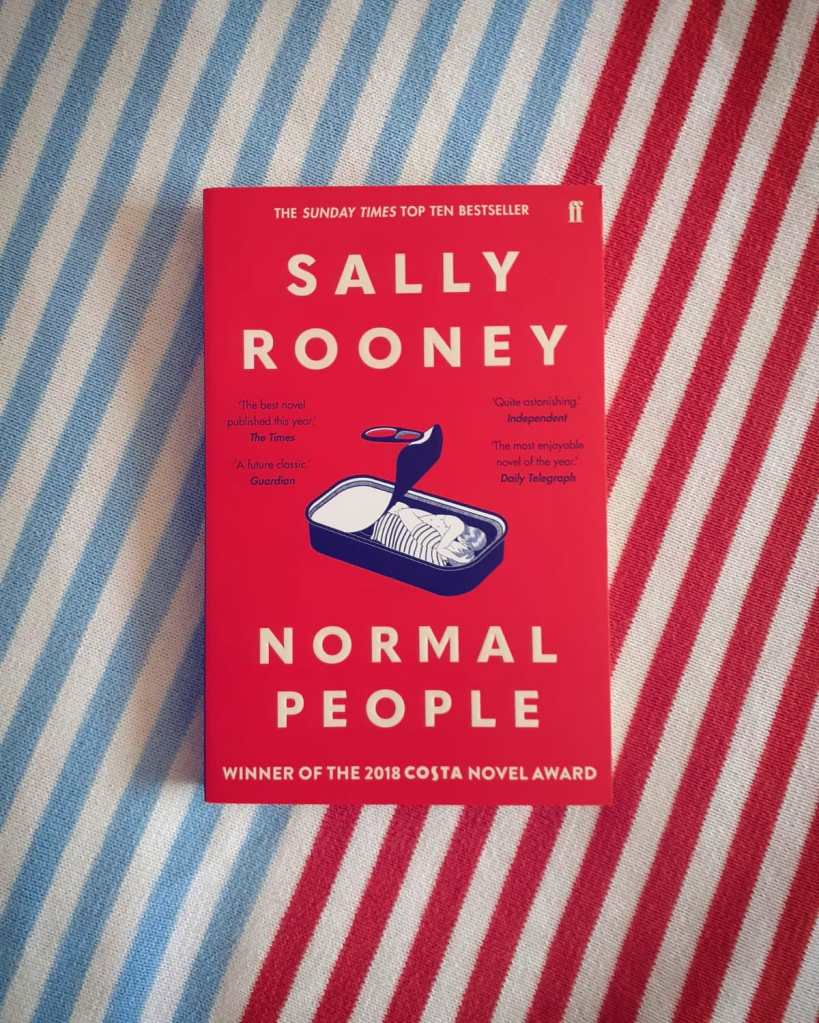
Review: Normal People – Sally Rooney

‘Connell wished he knew how other people conducted their private lives, so that he could copy from example …’ (p.49)

I have very mixed feelings about this book. Everyone raved about it when it was first published but it’s been sat on my shelf for a while, gathering dust. I finally picked it up because the series was about to be released … though now I wish I’d read it before even seeing the trailer – maybe I’d have imagined the characters differently. Overall, I liked the novel but found it dragged a bit; although I did want to know what happened next, I wasn’t desperate to find out, and it took me the best part of a month to finish, but this might say more about my attention span than the novel! Perhaps if I’d had read it over just a few days, this would not have been the case?

What I didn’t like:

At times I found aspects of the main characters and their story-line frustrating, both in terms of their individual behaviour and ‘back and forth’ nature of their relationship. My attitude towards the two of them changed constantly throughout the novel. Connell’s treatment of Marianne at school was irritating, and he fully deserved the tongue-lashing he got from Lorraine. But, however unfortunately, it is fairly realistic. You could argue that part of what makes this section so uncomfortable is that readers remember their own experiences of secondary school, ‘imbued with such drama and significance’ (p.77) at the time. The hyper-awareness of others’ opinions and changes in behaviour accordingly, maybe in a way they’d now be ashamed of. Whatever the reason, the early tone of the novel touches a nerve.

As such, there is something very universal in Connell’s realisation that no one cared as much as he had thought:

‘This was the most horrifying thing Eric could have said to him, not because it ended his life, but because it didn’t. He knew then that the secret for which he had sacrificed his own happiness and the happiness of another person had been trivial all along’ (p.77)

Marianne’s ambivalence to other people’s opinions is arguably a trait to be admired. However, this initial display of fierce independence makes it all the more frustrating and upsetting that she allows Jamie, then Lukas to treat her so badly; Connell voices (or rather internally monologues) a similar opinion.

The chronology also took me a while to get my head around; the first few chapters are a little jolting but then you get used to the structure – it reminded me of ‘One Day’, skipping to certain points of their relationship, and then filling in the gaps retrospectively.

The speech formatting – I know this is an artistic choice and a silly thing to complain about but at times it was hard to tell what was speech and when we’d moved back to internal dialogue.

Peggy – a terrible friend and person …

What I liked:

I was frustrated by Marianne and Connell at times but writing this review, I’m reminding myself that good writing isn’t creating completely likeable characters – that would be unrealistic, not to mention boring! Generating any emotional reaction, positive or negative, to words on a piece of paper means the author has achieved something.

I empathised with both of them at different points, especially with Connell’s anxieties about university and the opinions of other. They are both flawed, but you can see over the course of the book how they make each other better people. For me, the ‘normal’ presentation of their relationship worked well – it wasn’t sensationalised/overly-romanticised but was still intimate and affecting.

Sally Rooney writes three-dimensional characters very well, in the sense that she shows all sides of them – not just the good and the bad, but the mundane moments, their silliness and humanity. What I particularly enjoyed was her talent for  making you like the character but understand why other’s might not … I can easily imagine that if I were to bump into Marianne at a party, I might well share Helen’s opinion, finding her self-absorbed and irritating. But with context and the insight of how Connell views her, she is presented differently. Equally, though you have the internal dialogue from Connell that explains his decisions/rationalises his decisions from his perspective, it’s easy to see how these actions are confusing to other people and have the potential to hurt those around him, however unintentionally.

Also, I like learning new things and I now know what a ‘press’ is in Ireland …

Rating: 3.5 out of 5.

|Mental Health Awareness Week|

Over the past few days, I’ve made a few book recommendations on Instagram in recognition of Mental Health Awareness Week. As per my usual ‘procrastinatory’ ways, I’m a day late in posting this … the official week actually ended yesterday but I wanted to share these all the same:

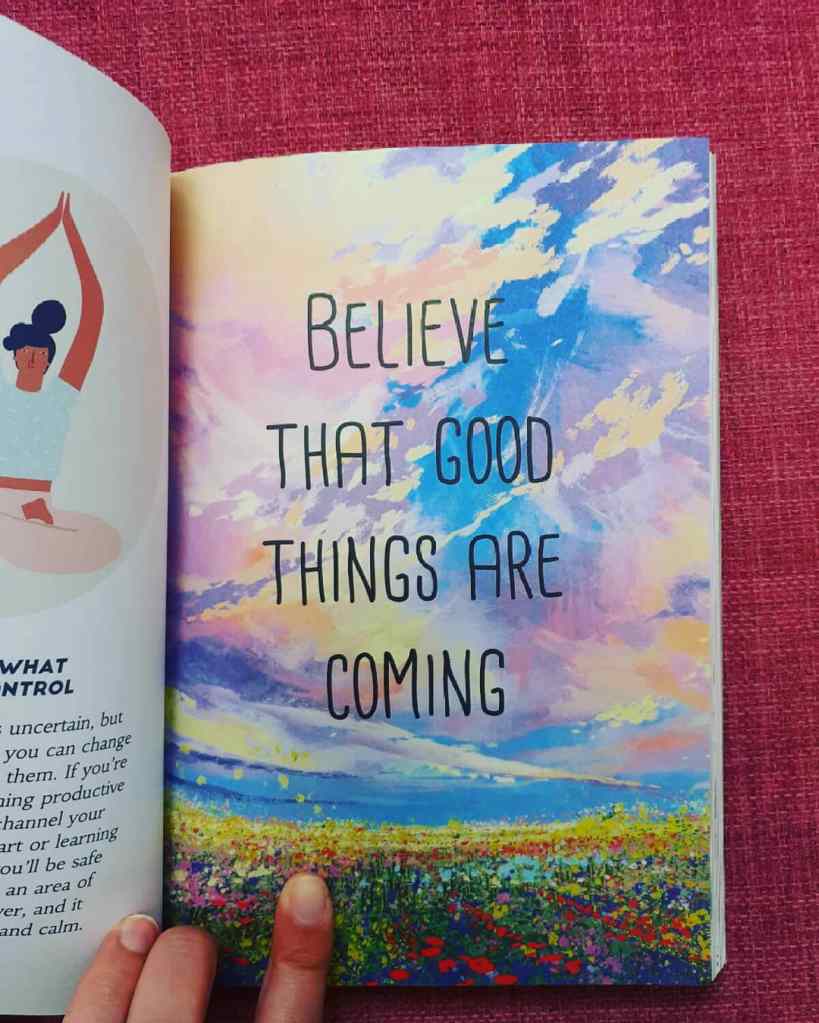
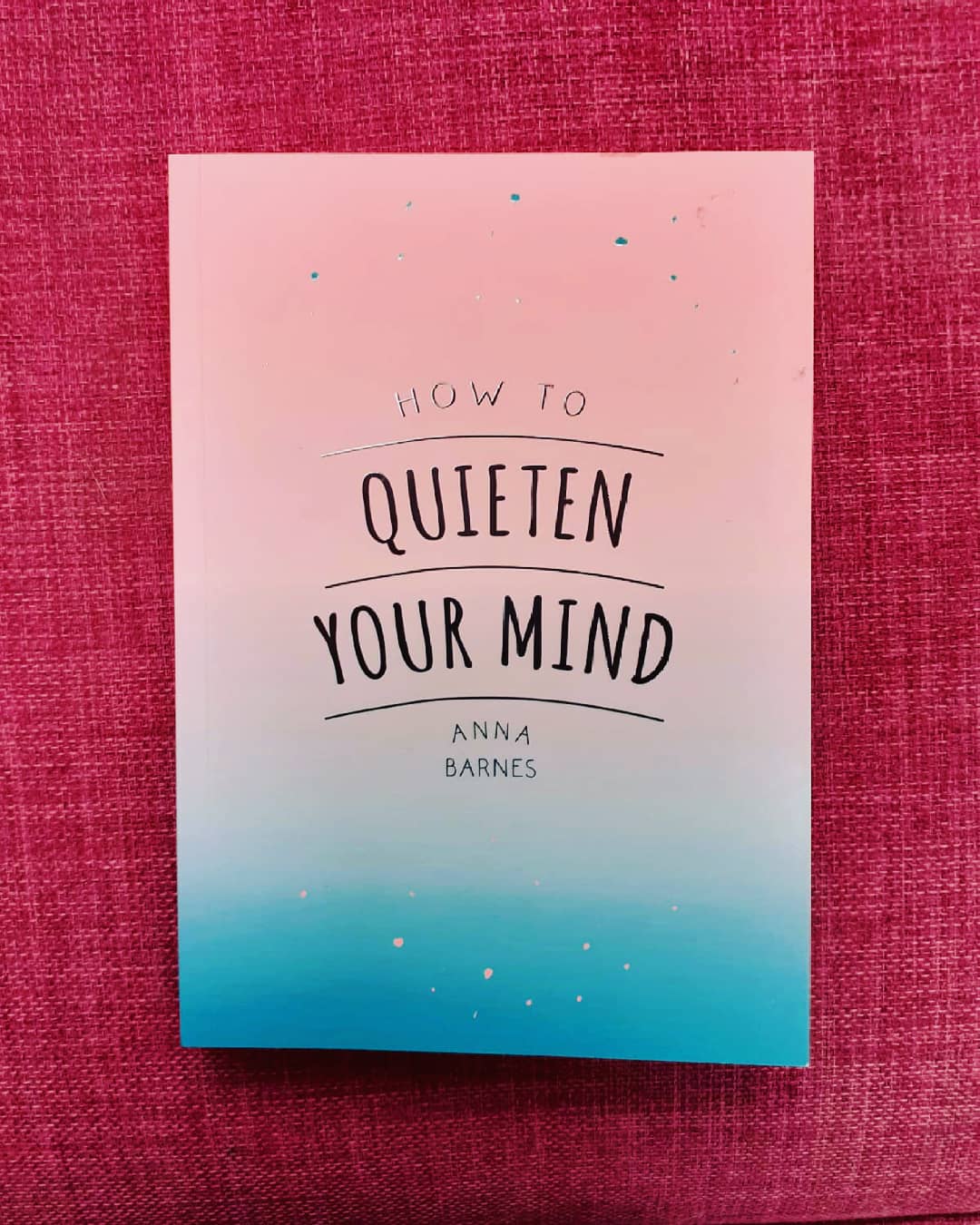
  1. How To Quieten Your Mind – Anna Barnes

This little gem of a book was a gift from a friend. Full of wise words and beautiful illustrations, it’s the perfect ‘pep talk in paperback’ for your bedside table.

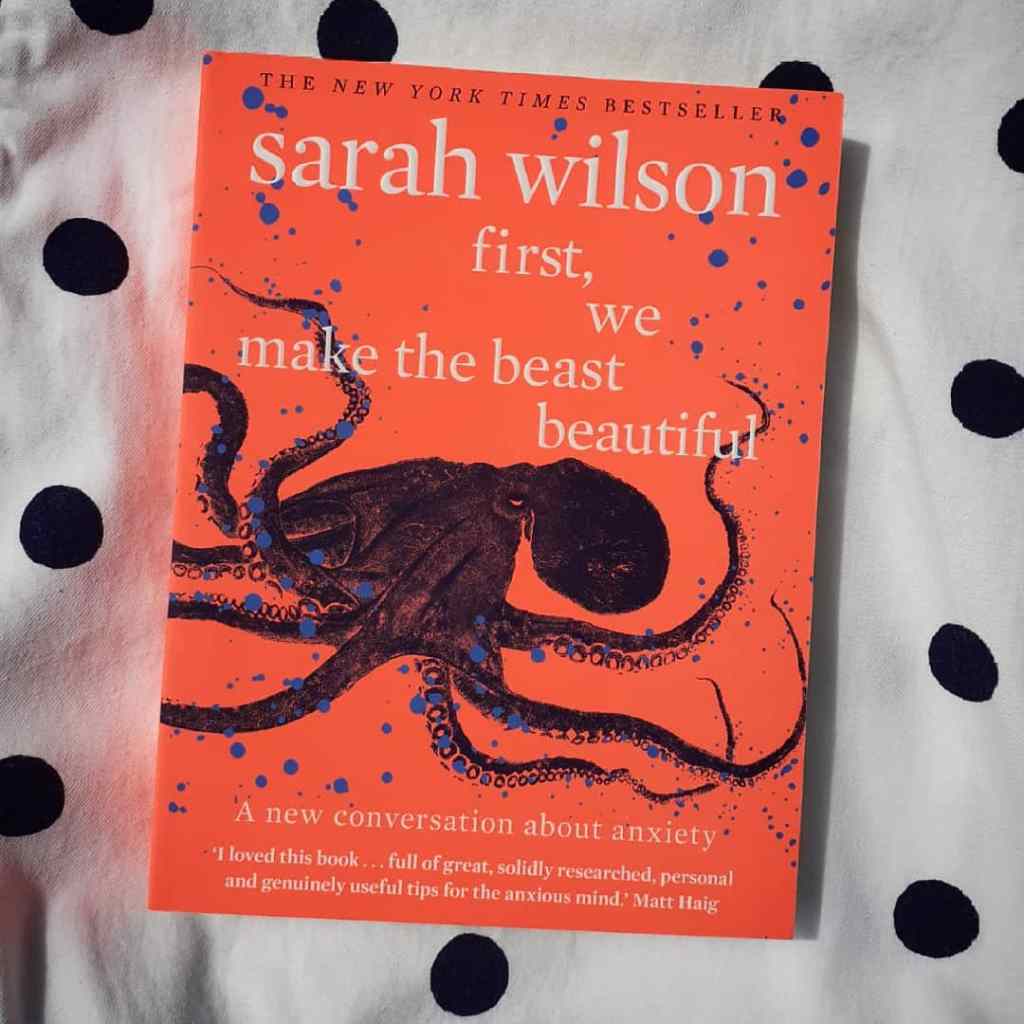
2. First, We Make The Beast Beautiful – Sarah Wilson

If I’m being honest, I first picked this up for its very cool cover and intriguing title. However, I bought it after reading the first few pages. This book is quite unlike anything I’ve read before, in a way that is hard to articulate. It’s chatty yet formal, personal yet universal and above all, empathetically reassuring.

3. Overcoming Anxiety Without Fighting It – Dr Tim Cantopher

Of the three, I would say I found this the most practically helpful. It is certainly the most scientific – the author is a consultant psychiatrist – though it’s far from just a medical textbook. He discusses anxiety disorders in depth, the potential causes and consequences, as well as coping strategies and possible treatment avenues.

**Also, if you aren’t already familiar with the charity Mind, please visit their website for a nose around – the work they do is fantastic**