Review: Winter Flowers by Angélique Villeneuve

It is seldom that I’ve read such a short, simple book that has stayed with me so persistently after the final page.

Winter Flowers (Les Fleurs d’hiver), translated from the French by Adriana Hunter, is a subtly nuanced family drama, set against the backdrop of war-stricken Paris. For two years, Jeanne Caillet and her young daughter Léonie have lived alone within the walls of their small apartment, surviving food shortages and bitter winters on the paltry sum Jeanne collects for the exquisite artificial flowers she crafts.

‘When making flowers, Jeanne metamorphoses into an incredibly self-possessed creature whose focus, skill and attention to detail enthral anyone who has the opportunity to watch her work. She can make 900 cowslip flowers in a day. Her hands produce improbable tea roses as opulent as lettuces, explosive swells of petals speckled with a shimmer of blood red or cherry red. She conjures up clusters, stalks and ears, umbels and flower heads, all more beautiful and more real than the real thing.’
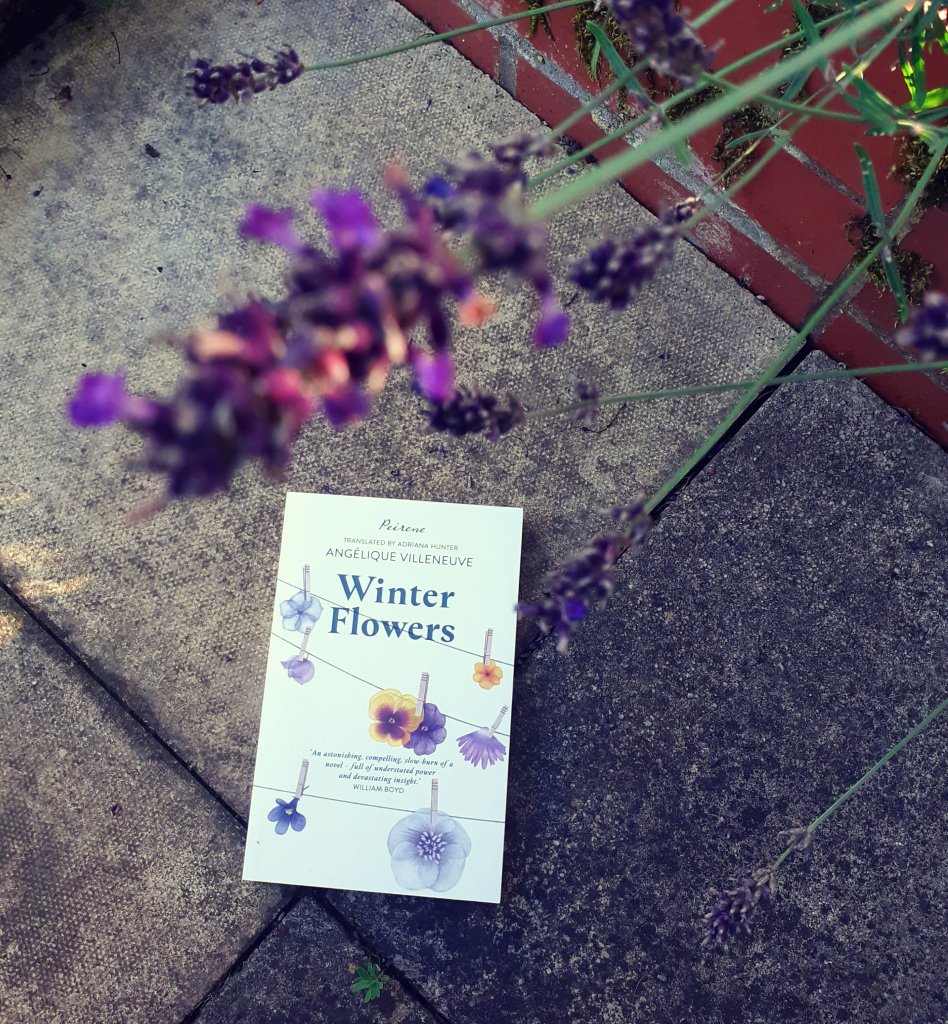
The return of Toussaint, her husband, from the facial injuries ward of a military hospital unsettles this difficult but established routine, bringing new challenges and conflicting emotions into their lives, as they must learn once more to be a family of three. For Jeanne in particular, overwhelming relief is distorted by frustration, confusion and hurt. Guilt contributes to this precarious cocktail of feelings in the wake of her neighbour, Sidonie’s, tragedies and palpable fear courses throughout the novel, intensified by stark reminders of brutal wartime realities.

In my opinion, the real triumph of this novel is its simplicity; the plot is as delicate as the silken flowers that pass through the flower maker’s hands. Significance is woven into the fabric of the book not by dramatic events but by the characters’ emotions, most of which are speculated by Jeanne; though third-person, the narrative threads centre around her thoughts.

One motif I particularly enjoyed was the parallels drawn between Toussaint and the flowers. His eyes are ‘of a blue that hovers between nigella and chicory’ and careful details of his surgeries are interlaced with the creation process.

‘In two separate incisions, one on the inside, the other outside, the edges of the aperture and the whole fibrous mass are excised. / Hyacinths come in soft, subdued colours: blue, mauve, pinkish and red are achieved with rinses from various concentrations of lapis lazuli, crimson lake, magenta lake or carmine. / Using a buttonhole incision made in the cheek, a scalpel is introduced flatways from front to back under the integument.’

The titular flowers feature heavily throughout, gossamer and impossibly beautiful, an focal point around which all other elements revolve.

‘Her first cornflower in silk muslin, then a peony, a camellia, a Chinese primrose, sweet peas, a hyacinth, six different varieties of rose, lilac, clematis […] and an intricately veined lily. Lolling over to one side there’s even a poppy with a contorted stem and petals in a spectacular orange, as vibrant as poison’.

Winter Flowers is the first of Villeneuve’s novels to be translated into English, having already won an array of French literary prizes. It is the fifth work Adriana Hunter has completed for Peirene, joining titles such as Véronique Olmi’s Beside the Sea and Her Father’s Daughter by Marie Sizun.

The novel will be part of the newly announced Borderless Book Club Autumn Programme, on the 21st October.

Be sure to catch up with the latest Indie Insider issue to read my interview with Stella Sabin, publisher at Peirene Press!
Rating: 4 out of 5.

Women in Translation Month

It’s August, which means Bookstagram is full of incredible Women In Translation Month features! As someone who avidly reads both translated fiction and work by women writers, it’s like Christmas come early (to the extent that I briefly considered adding ‘It’s the Most Wonderful Time of the Year’ as a backing track for this post …)

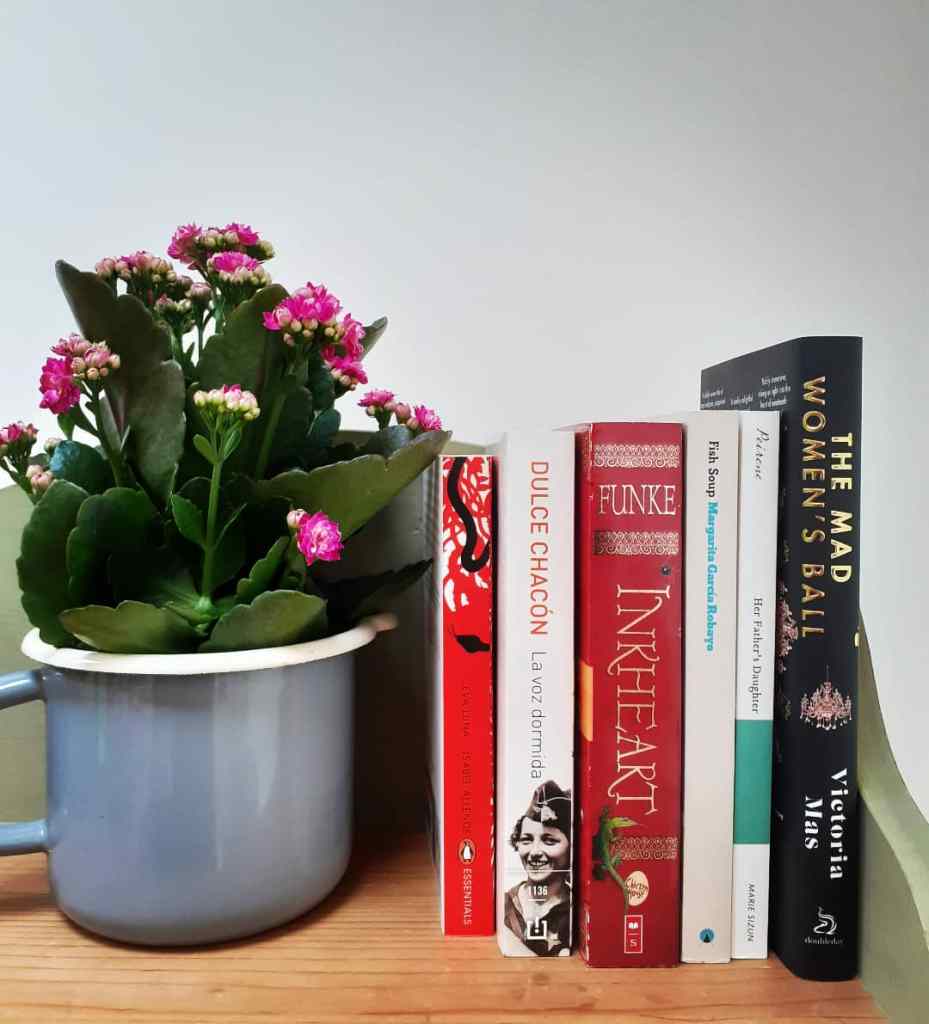
Here are just a few of my own picks:


🇨🇱 Eva Luna – Isabel Allende (transl. Margaret Sayers Peden)

This has been on my TBR list of a while, ever since I read and loved The House of Spirits. Allende’s prose is beautiful – I always find myself utterly immersed in the worlds she creates.

‘My name is Eva, which means “life”, according to a book of names my mother consulted. I was born in the back room of a shadowy house, and grew up amidst ancient furniture, books in Latin, and human mummies, but none of those things made me melancholy, because I came into the world with a breath of the jungle in my memory.’


🇪🇸 The Sleeping Voice/La voz dormida – Dulce Chacón (transl. Nick Caistor)

This is severely underrated novel – if you are a fan of historical fiction, I cannot recommend it enough! Set in a women’s prison during the the Spanish Civil War and based on historical accounts, it follows the lives of Hortensia and her fellow inmates, deftly switching between timelines and characters to reveal a wider picture of the horrors many suffered at this time. I first read it in English translation at university and was blown away by the emotional impact of Chacón’s writing.

I only have the Spanish copy as I am now attempting (with varying degrees of success) to read it again in the original, but the English version is widely available and a must-read!


🇩🇪 Inkheart/Tintenherz – Cornelia Funke (transl. Anthea Bell)

A childhood favourite – every bookworm I know would give a right arm to enter their favourite fictional worlds. Premise aside, Cornelia Funke is a natural-born fantasy writer and Anthea Bell’s translation is beautifully fluid. Once you’ve raced through this trilogy and have been firmly converted to a fervent Funke fan, there’s also The Thief Lord and Dragon Rider awaiting you.


🇨🇴 Fish Soup – Margarita García Robayo (transl. Charlotte Coombe)

Another TBR that I’m very excited for! I have followed Charco Press for a while now; their work bringing Latin American authors to the forefront is incredible and I’m sure this is the first of many, many purchases.

“Throughout the collection, García Robayo’s signature style blends cynicism and beauty with an undercurrent of dark humour. The prose is at once blunt and poetic as she delves into the lives of her characters, who simultaneously evoke sympathy and revulsion, challenging the reader’s loyalties as they immerse themselves in the unparalleled universe that is Fish Soup” – https://charcopress.com/bookstore/fish-soup


🇫🇷 Her Father’s Daughter/ Le père de la petite – Marie Sizun (transl. Adriana Hunter)

I bought this immediately after finishing Adriana Hunter’s translation of Winter Flowers by Angélique Villeneuve, also published by Peirene. Upon reading the blurb, the premise is remarkably similar – a father returning home to his family and the ensuing complications, set against the backdrop of war-torn Paris. I like the subtilty of Winter Flowers so hopefully that bodes well.


🇫🇷 The Mad Women’s Ball/Le bal des folles – Victoria Mas (transl. Frank Wynne)

This was very much a “bookstagram made me do it” purchase. I am intrigued by the trope of women and madness; I read Gilbert and Gubar’s work cover to cover while studying and each fictional exploration of the topic brings a new perspective to light. Moreover, Gothic fiction is right up my street so tentatively hoping this one will be a 5* review.

“A darkly sumptuous tale of wicked spectacle, wild injustice and the insuppressible strength of women” – Emma Stonex, author of The Lamplighters

Review: Once – Morris Gleitzman

‘I got you the boots because everybody deserves to have something good in their life at least once’

‘Once’ by Morris Gleitzman

Currently reading this book with my class as part of our World War 2 topic. It reminds me a lot of John Boyne’s ‘The Boy in the Striped Pyjamas’ but in this case from the perspective of a Jewish boy called Felix in Poland. An interesting read yet, in class discussions, I’m aware that the inference is fairly subtle with regard to the contextual events engulfing Felix’s life – more so than I had first thought. As such, my interpretation of the book was very different to that of the students, sort of reiterating the author’s point!?
The sparks of humour are also nuanced; there were more than a few parts that made me chuckle. But then just as many that had me misty-eyed or teary intermittently throughout …

‘Even the nuns don’t get whole carrots, and they get bigger servings than us kids because they need extra energy for being holy’

‘ “Yes but where?”, says a woman wearing a scarf. A man with his arm round her rolls his eyes. He looks like he’s done it before, so he’s probably her husband’

‘Thank you God, Jesus, Mary, the Pope and Richmal Crompton!’

Rating: 3 out of 5.

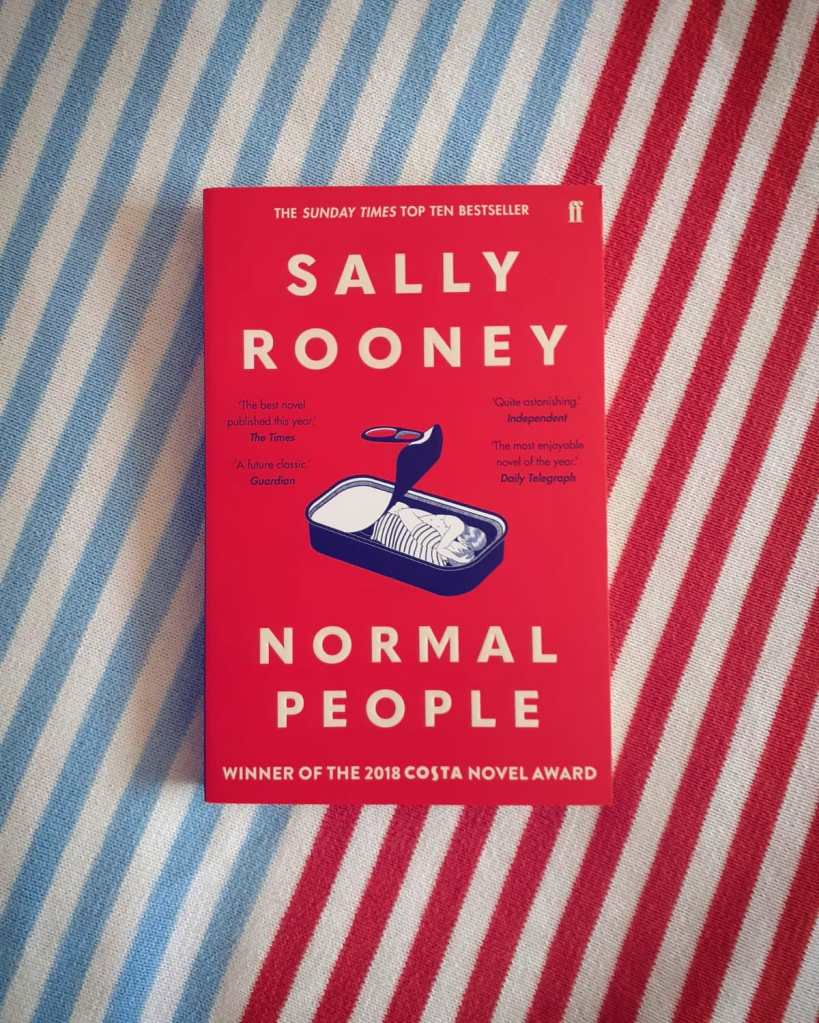
Review: Normal People – Sally Rooney

‘Connell wished he knew how other people conducted their private lives, so that he could copy from example …’ (p.49)

I have very mixed feelings about this book. Everyone raved about it when it was first published but it’s been sat on my shelf for a while, gathering dust. I finally picked it up because the series was about to be released … though now I wish I’d read it before even seeing the trailer – maybe I’d have imagined the characters differently. Overall, I liked the novel but found it dragged a bit; although I did want to know what happened next, I wasn’t desperate to find out, and it took me the best part of a month to finish, but this might say more about my attention span than the novel! Perhaps if I’d had read it over just a few days, this would not have been the case?

What I didn’t like:

At times I found aspects of the main characters and their story-line frustrating, both in terms of their individual behaviour and ‘back and forth’ nature of their relationship. My attitude towards the two of them changed constantly throughout the novel. Connell’s treatment of Marianne at school was irritating, and he fully deserved the tongue-lashing he got from Lorraine. But, however unfortunately, it is fairly realistic. You could argue that part of what makes this section so uncomfortable is that readers remember their own experiences of secondary school, ‘imbued with such drama and significance’ (p.77) at the time. The hyper-awareness of others’ opinions and changes in behaviour accordingly, maybe in a way they’d now be ashamed of. Whatever the reason, the early tone of the novel touches a nerve.

As such, there is something very universal in Connell’s realisation that no one cared as much as he had thought:

‘This was the most horrifying thing Eric could have said to him, not because it ended his life, but because it didn’t. He knew then that the secret for which he had sacrificed his own happiness and the happiness of another person had been trivial all along’ (p.77)

Marianne’s ambivalence to other people’s opinions is arguably a trait to be admired. However, this initial display of fierce independence makes it all the more frustrating and upsetting that she allows Jamie, then Lukas to treat her so badly; Connell voices (or rather internally monologues) a similar opinion.

The chronology also took me a while to get my head around; the first few chapters are a little jolting but then you get used to the structure – it reminded me of ‘One Day’, skipping to certain points of their relationship, and then filling in the gaps retrospectively.

The speech formatting – I know this is an artistic choice and a silly thing to complain about but at times it was hard to tell what was speech and when we’d moved back to internal dialogue.

Peggy – a terrible friend and person …

What I liked:

I was frustrated by Marianne and Connell at times but writing this review, I’m reminding myself that good writing isn’t creating completely likeable characters – that would be unrealistic, not to mention boring! Generating any emotional reaction, positive or negative, to words on a piece of paper means the author has achieved something.

I empathised with both of them at different points, especially with Connell’s anxieties about university and the opinions of other. They are both flawed, but you can see over the course of the book how they make each other better people. For me, the ‘normal’ presentation of their relationship worked well – it wasn’t sensationalised/overly-romanticised but was still intimate and affecting.

Sally Rooney writes three-dimensional characters very well, in the sense that she shows all sides of them – not just the good and the bad, but the mundane moments, their silliness and humanity. What I particularly enjoyed was her talent for  making you like the character but understand why other’s might not … I can easily imagine that if I were to bump into Marianne at a party, I might well share Helen’s opinion, finding her self-absorbed and irritating. But with context and the insight of how Connell views her, she is presented differently. Equally, though you have the internal dialogue from Connell that explains his decisions/rationalises his decisions from his perspective, it’s easy to see how these actions are confusing to other people and have the potential to hurt those around him, however unintentionally.

Also, I like learning new things and I now know what a ‘press’ is in Ireland …

Rating: 3.5 out of 5.

Review(ish): Twas The Nightshift Before Christmas – Adam Kay

“Full marks to the anaesthetist wearing a badge that says: ‘He sees you when you’re sleeping, he knows when you’re awake’.”

IMG_20200520_124714_337
A very un-Christmassy photo


Essentially, see my previous review of ‘This Is Going To Hurt’ (⭐⭐⭐⭐⭐) but just add in some mistletoe and bauble-based injuries!

I know it’s a cop out, not writing another separate review, but I couldn’t think of anything vastly different to say … The book is unmistakably Adam Kay – gallows humour and blistering honesty – so, like the first one, it is very VERY good!

B x